 Feeding Mechanics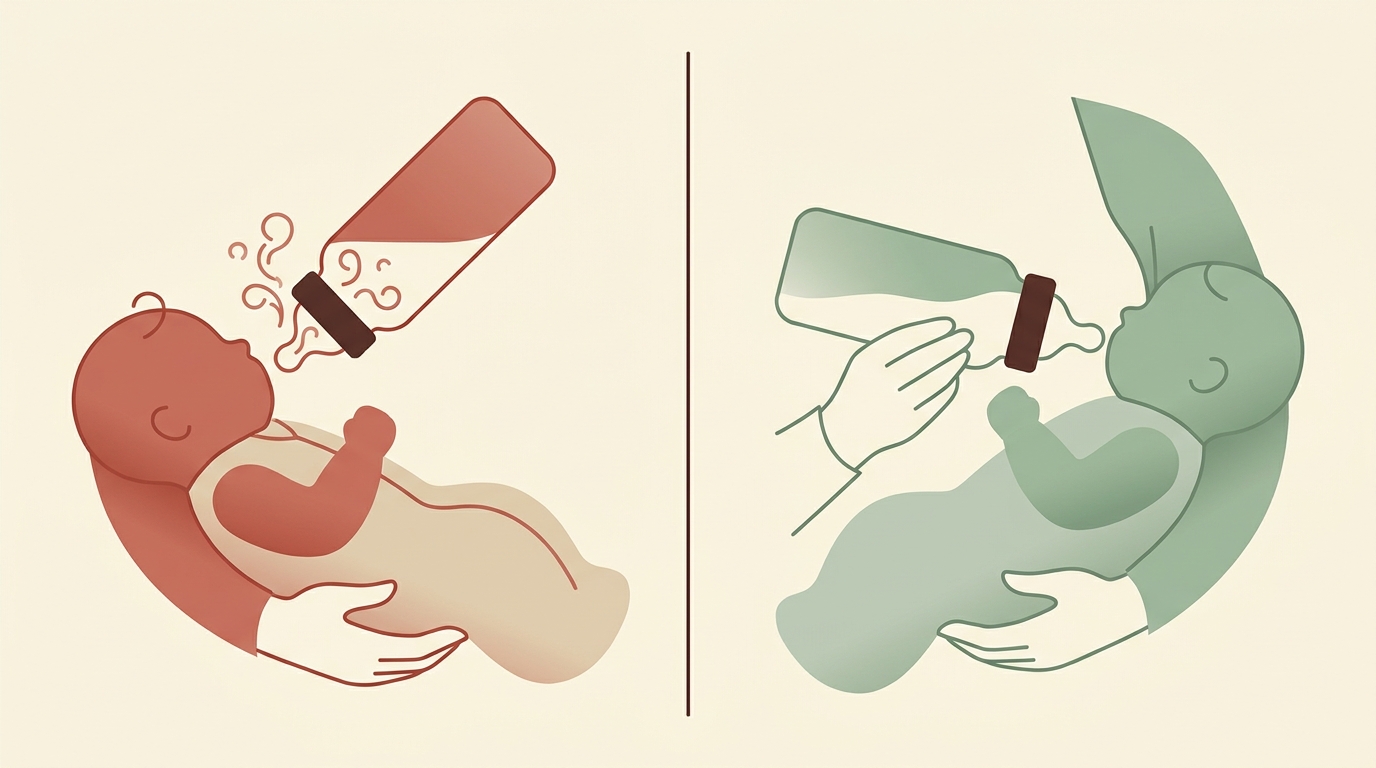
A steeply tilted bottle, held the way most people instinctively hold one, feels efficient. Milk flows continuously, feeding goes faster, and it looks like nothing is going wrong. The problem shows up two to four hours later, not during the feed itself, which is exactly why the connection between bottle angle and evening crying gets missed so often.
Here's the mechanism. A newborn's suck-swallow-breathe coordination is still developing. When milk flows continuously, gravity does the work instead of the baby controlling the pace, and air gets swallowed along with milk on nearly every gulp. That air doesn't cause a problem at the feed itself. It sits in the stomach, ferments over the following hours, and surfaces as exactly the kind of evening crying window most parents assume is unrelated to that afternoon's bottle.
Paced bottle feeding addresses this directly:
- Hold your baby near-upright, not reclined
- Hold the bottle horizontally rather than angled steeply down
- Keep the nipple only half-filled with milk, the rest air, so there's a natural pause built in
- Let your baby control suck speed rather than gravity controlling flow
- Every 20 to 30 seconds, tilt the bottle down briefly so your baby pauses and breathes
This typically extends a feed to 15 to 20 minutes rather than a faster gulped feed, and that extra time also gives your baby's stomach a chance to signal fullness to the brain before overfeeding compounds the air problem further.
Paced feeding cuts air intake substantially compared to a steep-angle bottle, and the extra time also lets a baby's stomach signal fullness before overfeeding compounds the problem.Mechanism behind the paced-feeding technique
This is one of the most consistently observed patterns in colic content generally: a bottle-position comparison is often the single highest-engagement, most-saved piece of content for exactly this reason, parents recognize their own feeding setup immediately. If bottle-feeding isn't the relevant picture for your baby, either because you're breastfeeding or because gut or nervous system factors seem more central, see the root-cause guide. Paced feeding pairs directly with Gentle Burping Techniques as the two feeding-mechanics levers that work together.
Not sure which of the three systems is driving your baby's crying? A 90-second assessment sorts that out and hands you straight into a guided, timed protocol for tonight.
Take the 90-second assessment