 Instant Digital Access
You’ve tried five things this week.
You can’t tell which one helped.
This is how you find out.
Pick a starting point, change one thing at a time, and log what happens. A 54-page illustrated management system with 11 clinical plates.
Want a free starting point first? Take the 90-second assessment →
“It had everything I had spent weeks learning on my own, plus so much more, all organized into one resource that was actually easy to understand.”
Read her full review
I came across The Colic Protocol’s Instagram when my baby was 11 weeks old. It was 5 a.m. after a really rough night, and as soon as I saw the Blueprint, I purchased it. At that point, I had already spent about five weeks doing my own research on colic and reflux. I was spending hours Googling, reading, and trying to figure out what could be going on with my baby. Anytime she was finally asleep, I was researching.
When I opened the Blueprint, I was honestly blown away. It had everything I had spent weeks learning on my own, plus so much more, all organized into one resource that was actually easy to understand. I immediately wished I had found it sooner because it would have saved me so many hours of searching and trying to piece everything together myself.
72-hour guarantee. You keep the Blueprint either way.
You have probably already done the right things.
You tried the gas drops. Maybe the gripe water. You read forums until your eyes hurt, and every one told you something different.
Here is the part nobody says out loud. When you change three things in one night, you cannot tell which one helped, or whether anything did.
That is not a you problem. It is a tools problem.
These weeks cost more than sleep. They cost patience with the person next to you, and some of your trust in your own judgment. The Blueprint can’t give those weeks back. What it can do is turn the guessing into a plan.
Three places to start. One change at a time.
Colic has no single known cause. So the Blueprint gives you three practical places to start, then helps you test them in order. They are a way to choose your first step, not a diagnosis.
A way to choose your first step, not a diagnosis.
Find your starting point
Answer a few questions about when and how your baby cries. You get the pattern that fits best.
Change one thing
Use the steps for that pattern, starting tonight. If nothing shifts after a fair trial, move to the next one.
Log it and check in
Track each cry in the Bloom Baby Tracker App. At 72 hours, look at the log and see what moved.
Your first 72 hours, in three steps
Pick your starting point and make one change.
Log every cry. Keep everything else steady.
Check the log. A shift? Keep going. No shift? Write to me.
The 72 hours covers the first changes: feeding, positioning and soothing. It isn’t a promise about any single product. Probiotic trials measured change over weeks, so judge that step on a longer clock.
Four parts, built to work together.
One download. You can use it the night you buy it.
Illustrated guide
54 pages with 11 full-color clinical plates: anatomical holds, latch mechanics, paced bottle angles, and gentle massage.
Bloom Baby Tracker App
Free digital companion web app. One-tap logging for crying, feeds, and soothing so you can see your baby’s real pattern.
60-Minute Brown Noise Soundscape
A steady track for the room. Keep it quiet and low, across the room, on a timer.
Cry Decoder Masterclass
Audio lessons on listening to your baby’s cry and logging what you hear, so patterns show up in the tracker.
Inside the Illustrated Edition
Starting-point assessment
Clear criteria to identify whether your baby’s crying pattern points toward gut microbiome, nervous system, or feeding mechanics.
Gut support & evidence
The probiotic strain and trial data (breastfed results and formula-fed caveats), plus a pediatrician discussion guide.
Illustrated soothing
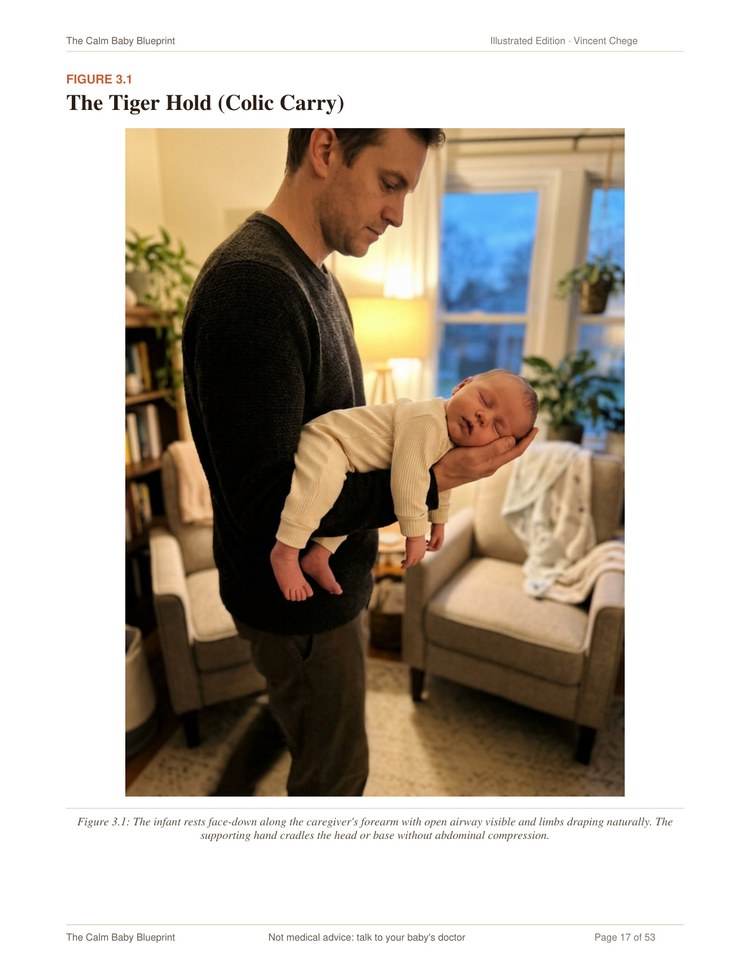
Forearm positioning for the Tiger Hold and anatomical I-L-Y abdominal massage guides to relieve trapped gas.
Feeding mechanics
Clinical figure plates for the Flipple deep-latch technique and horizontal paced bottle feeding.

I’m Vincent. Zion is my daughter.
When Zion was 3 weeks old, her colic was severe. We were told to wait it out. Waiting was not something I could do at 3 AM with her in my arms.
I am an epidemiologist, so I did the one thing I know how to do. I went back to the research, read what the studies actually found, and built a plan for her. Within 48 hours, her crying had settled.
That was one baby, with no control group, and colic often eases on its own. It is why I wrote this down for other parents, and why I am careful about what I claim.
What I am: someone trained to read and weigh research. What I am not: a pediatrician, a GI specialist or a lactation consultant. Please keep yours in the loop.
What the studies show, and what they don’t.
You are going to check this anyway. So here it is, including the part that is not flattering.
One small trial in breastfed babies
Savino et al., Pediatrics, 2010. 50 exclusively breastfed babies (46 finished) got the probiotic L. reuteri DSM 17938 or placebo drops for 21 days. By day 21, median crying time was 35 minutes a day on the probiotic and 90 on placebo. Both groups improved. Small trial, breastfed babies only.
A larger trial found no difference
Sung et al., BMJ, 2014. 167 babies under 3 months, breastfed and formula-fed, got the same probiotic or placebo for a month. Crying and fussing time were similar in both groups, in breastfed and formula-fed babies alike.
A modest effect at best
Later pooled analyses. Combining several trials suggests a modest effect, mostly in breastfed babies, with a lot of uncertainty.
Paced feeding for colic
It slows the flow and makes feeds last longer. Whether that reduces colic has not been proven.
Nothing here is a promise. No single product is the answer. That is why the Blueprint starts with feeding and soothing steps, and treats the probiotic as an option to talk through with your pediatrician.
I would rather you know all of this before you buy than find it out later.
Who this is for, and who it isn’t.
- Your baby is about 2 to 12 weeks old and the crying does not look like “just tired” or “just hungry”
- You breastfeed, formula-feed or do both. Each has its own steps
- You have already tried a remedy or two and want a way to tell what actually helps
- You want to understand the why, not just follow steps blindly
- Your baby has a confirmed reflux (GER or GERD) diagnosis. That is a different conversation with your pediatrician
- Your baby is past 12 weeks and the crying has already settled on its own
- You want a promise that the crying will stop. This is a management system, and results vary
Call a doctor first if you see any of these
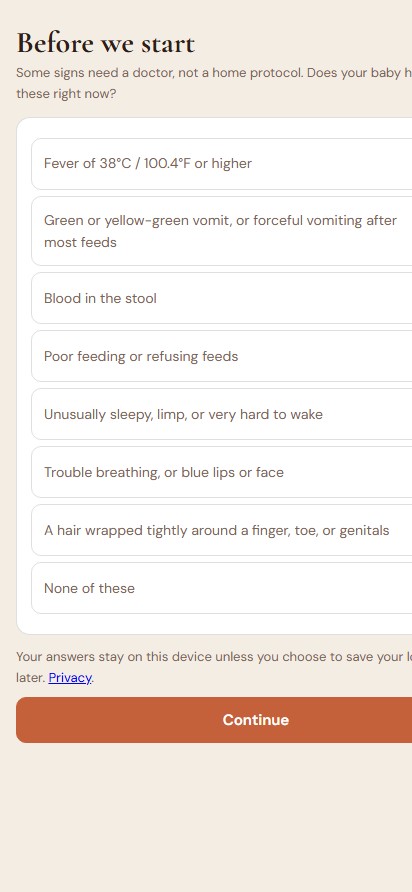
A fever, green or bilious vomiting, blood in the stool, poor feeding, or a baby who is unusually sleepy or limp. These need medical care before any home plan. If something feels wrong to you, trust that and call.
If none of these apply, you can start tonight.
No meaningful shift in 72 hours? Get a full refund.
Use the Blueprint’s first changes for 72 hours and check your log. If nothing meaningful has shifted, email hello@colicprotocol.baby and I’ll refund you in full. You can ask any time in the first 30 days. No forms. You keep the Blueprint, the tracker and the soundscape either way.
The 72 hours covers the Blueprint’s first changes, like feeding, positioning and soothing. It is not a promise about any single product.
Before you buy
Is this just another thing that won’t work?
It doesn’t ask you to believe in it. You change one thing, log what happens and look at the result. I can’t promise it will work for your baby, and nobody honestly can. If nothing moves in 72 hours, you get a full refund.
How fast will I see a difference?
At 72 hours you’ll know whether your log has moved after the first changes. Probiotic trials measured change over weeks, not days, so judge that step separately. Colic often peaks around week 6 and eases by about 3 to 4 months, so the goal is a plan for getting through those weeks.
What about my pediatrician?
Keep them in the loop. The Blueprint does not replace medical care. The tracker log is easy to show at an appointment, and any red-flag sign such as fever, green vomit, blood in the stool, poor feeding or unusual sleepiness needs a doctor first.
Is the brown noise safe for my baby?
My advice is to keep any sound quiet and low, across the room, on a timer. Never run it loud or right next to the crib. If you have questions about sound for your baby, ask your pediatrician.
Is this different for breastfed and formula-fed babies?
The steps are different: latch for breastfeeding, paced feeding and bottle position for bottles. On the probiotic, the one small trial with good results was in exclusively breastfed babies, and a larger trial of breastfed and formula-fed babies found no difference in either group. So the Blueprint treats it as an option to discuss with your pediatrician, not a first step.
What does the guarantee cover?
The first changes, for 72 hours: feeding, positioning and soothing. If nothing meaningful has shifted, email me and you get a full refund, any time in the first 30 days. It isn’t a promise about any single product.
Is this a subscription?
No. It is a one-time $47 purchase. No recurring charge, no upsell tier.
Do I need the free assessment first?
It helps. The Blueprint includes a deeper assessment, but the free 90-second version gives you a quick starting point tonight if you would rather begin there.
You don’t have to figure this out alone at 3 AM.
$47 one time. Instant download. 72-hour guarantee, and you keep the Blueprint either way.
Get the Blueprint, $47 →Not ready yet? Take the free assessment first.