 Nervous System
 Feeding Mechanics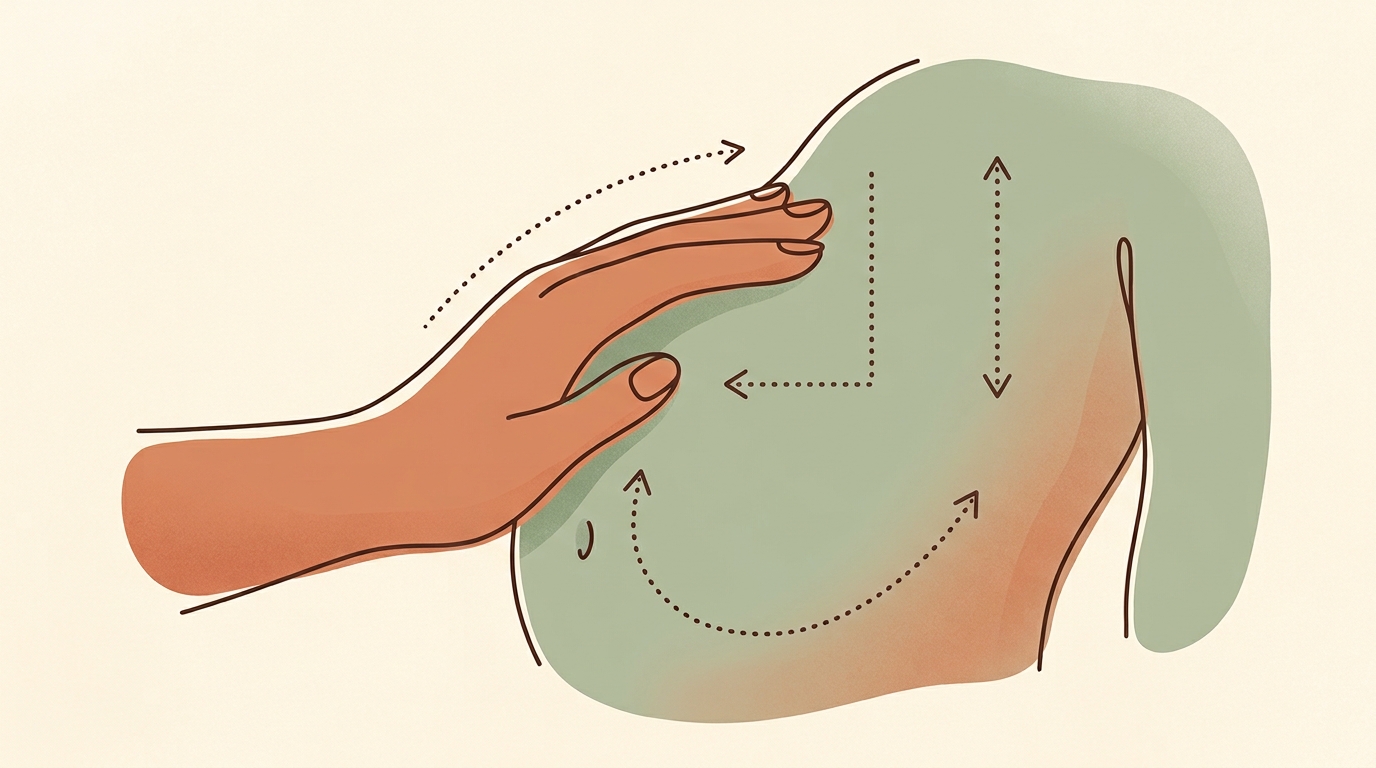
Infant massage sits at an interesting intersection for colic: it can support gas movement through the digestive tract (a mechanical, feeding-adjacent effect) while also calming an overstimulated nervous system through touch (a nervous-system effect). That dual role is part of why it's worth its own look.
The most directly relevant trial: Nahidi and colleagues (Iranian Journal of Nursing and Midwifery Research, 2017) randomly assigned 100 colicky infants to either a structured massage protocol or rocking, and found massage produced significantly greater reductions in crying frequency, duration, and overall severity across the one-week study period.
A commonly taught structured sequence is ILU Massage, named for the shapes traced on the abdomen: a stroke shaped like an "I" down the left side, an "L" tracing under the ribs and down, and a "U" continuing the motion around, following the natural direction of the large intestine. The physical logic is straightforward: gentle, directional pressure along the path gas naturally moves can help it along, while the skin-to-skin contact itself supports nervous system regulation through touch.
Two things worth being direct about, in the spirit of not overselling a gentle technique just because it's low-risk. First, the Cochrane review on manipulative therapies (Dobson D, et al., 2012) found that effects for hands-on techniques broadly tend to shrink once studies control for parental blinding, meaning some of what looks like improvement may be partly attributable to the attention and ritual of the technique itself, not only its mechanical effect. That's not a reason to skip massage; it's a reason not to expect it to work identically every time. Second, massage works best between crying episodes or as part of a calm wind-down routine, not as an attempt to interrupt an already-escalated crying spell, where Tiger Hold tends to be more effective.
This sits primarily in the Feeding Mechanics and Nervous System systems together. See the root-cause guide for the full picture, or Colic Holds Beyond Tiger Hold for how it compares to other physical techniques.
Not sure which of the three systems is driving your baby's crying? A 90-second assessment sorts that out and hands you straight into a guided, timed protocol for tonight.
Take the 90-second assessment