 Nervous System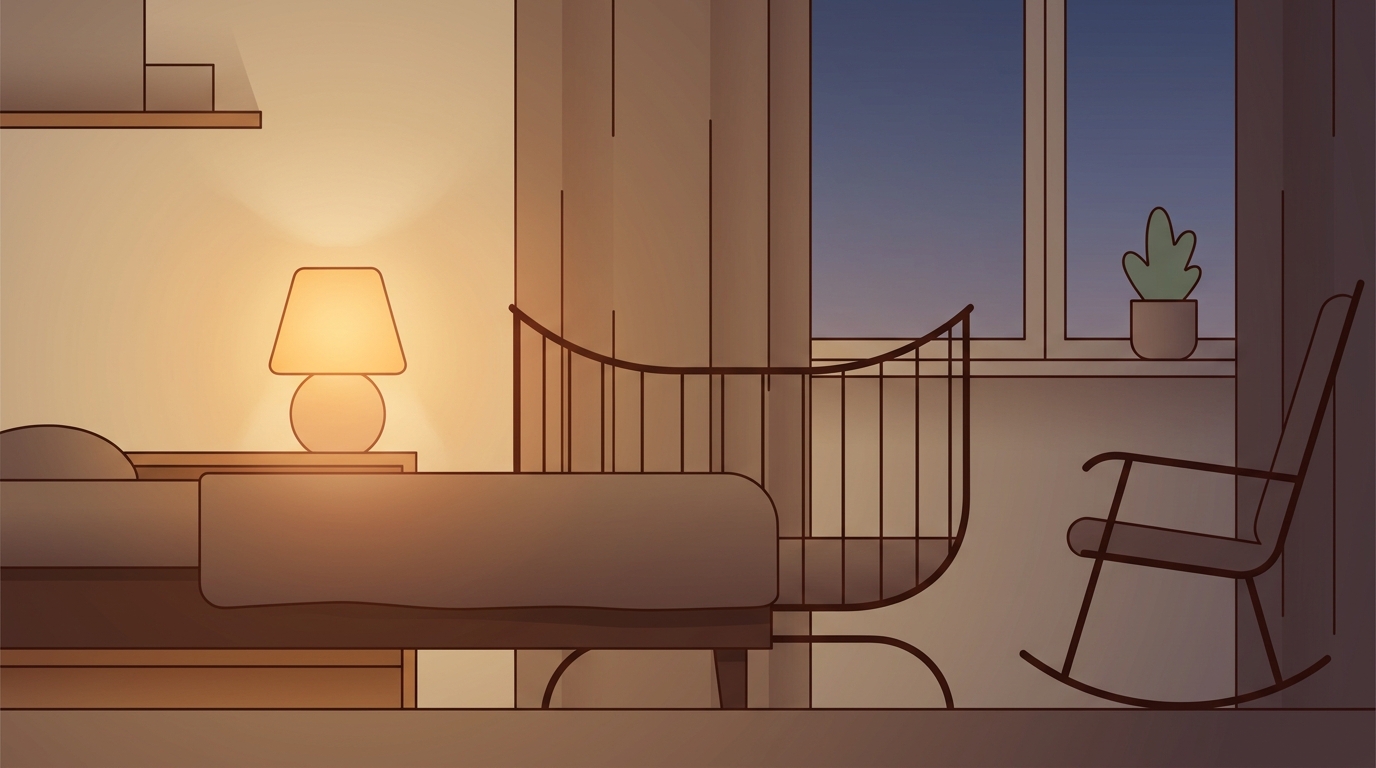
The evening crying window, often called the witching hour, tends to catch parents off guard because it doesn't respond to the things that work at other times of day. That's not a coincidence. By late afternoon, a newborn has been accumulating sensory input all day, and a natural circadian dip in the 5 to 7pm range tends to destabilize an already taxed nervous system further, right as parents are often trying to add more stimulation, not less, to keep a baby occupied until the next feed or bedtime.
The environment adjustment that tends to help most is the opposite instinct: reduce input rather than add it.
- Dim the room to roughly 40 to 50% of normal daytime brightness, ideally warm-toned light rather than cool white light. Bright light is associated with cortisol elevation; dim, warm light supports the shift toward parasympathetic (calming) nervous system activity
- Reduce visual stimulation. A screen on in the background, even muted, adds sensory load during a window when the goal is subtraction, not distraction
- Keep handling minimal and rhythmic rather than active. This is a moment for holding, gentle rocking, or Tiger Hold, not bouncing or active play
- Aim for consistency in timing. A predictable 30 to 60 minute wind-down window at roughly the same time daily helps a baby's nervous system learn to anticipate calm rather than stimulation at that hour
This is a lighter-weight companion to the more mechanism-heavy content on this site. It draws on the general principle that the evening window is a nervous-system-load problem, not a boredom or entertainment problem, which is the same reasoning behind Tiger Hold, Swaddling, and gentle massage as a calmer-moment complement to the room itself. If the evening window isn't where your baby's crying concentrates, or gut or feeding issues seem more central, see the root-cause guide.
Not sure which of the three systems is driving your baby's crying? A 90-second assessment sorts that out and hands you straight into a guided, timed protocol for tonight.
Take the 90-second assessment